
Views: 0 Author: Site Editor Publish Time: 2026-09-16 Origin: Site


Imagine spending half a shift laying down a flawless-looking bead on a high-pressure 6G pipe joint, only for the non-destructive testing (NDT) inspector to flag it for underbead cracking the next morning. Tired of failed X-ray tests and the endless, dirty grind of rework? You certainly aren't the only one out there facing this.
In structural and pressure-vessel fabrication, ambient moisture ruins low-hydrogen rods incredibly fast. Even a couple of hours exposed to a humid morning can compromise the chemical integrity of the flux. Fortunately, a properly sized welding rod dryer acts as your primary line of defense against atmospheric contamination. It prevents costly structural defects long before you even strike an arc.
However, buying the right equipment requires more than just grabbing a metal box that gets hot. You must carefully match the unit's thermal capabilities and holding capacity to your crew's specific daily burn rate. In this comprehensive guide, you will learn exactly what specifications are required to keep your consumables in peak condition and your welds strictly up to code.
Moisture is the Enemy: Even a brief window of atmospheric exposure can ruin low-hydrogen electrodes (like E7018), leading to costly structural weld defects.
Storage vs. Redrying: You need entirely different temperature ranges depending on whether you are simply maintaining factory dryness (holding/storage) or aggressively restoring moisture-compromised rods (redrying/rebaking).
Capacity Matters: Choosing between a small, mobile unit (10-20 lbs) and a massive stationary oven (400+ lbs) depends entirely on your crew size, job site location, and daily consumable consumption.
Compliance is Crucial: Following AWS and ASME standards for consumable management is non-negotiable for structural steel and pressure-vessel applications.
Understanding exactly how electrodes degrade isn't just theory—it is a critical operational reality for any fab shop or mobile rig. A dedicated rod oven is absolutely fundamental for maintaining the metallurgical integrity of the weld pool.
The flux coating on shielded metal arc welding (SMAW) electrodes is highly hygroscopic. It actively sucks moisture out of the air like a sponge. When a moisture-contaminated electrode is consumed, the intense heat of the welding arc violently breaks down those trapped water molecules (H₂O) into hydrogen and oxygen.
Consequently, the hydrogen gas dissolves directly into the molten weld metal. As the joint cools down and solidifies, the hydrogen tries to force its way out. If it becomes trapped in the solidifying metal or the heat-affected zone (HAZ), it creates massive internal stress. This phenomenon leads to underbead cracking, universally known as hydrogen-induced cracking (HIC) or cold cracking. Furthermore, the escaping gas can leave voids, resulting in severe porosity. Both defects destroy the tensile strength of the joint and guarantee a failed non-destructive evaluation.
The primary function of drying equipment is to create a controlled micro-environment that completely halts moisture absorption. By maintaining a continuous, elevated ambient temperature, the chamber prevents condensation and keeps the flux coating locked at its factory-specified moisture level.
Investing in proper consumable management directly correlates with massive operational cost savings. When electrodes are left exposed to the atmosphere beyond their specified limits, they must either undergo a lengthy, energy-intensive rebaking process or be thrown in the trash. More importantly, using compromised rods leads to defective welds that require tedious arc gouging, grinding, and re-welding. By utilizing reliable thermal storage, fabrication facilities minimize consumable waste and drastically reduce labor hours spent on rework.
A frequent point of confusion I see on shop floors is mixing up holding (storage) and rebaking (redrying). These two processes require vastly different thermal profiles and serve entirely different purposes. Selecting the wrong temperature can either fail to remove deeply embedded moisture or permanently destroy the electrode.
Holding ovens are designed for one highly specific purpose: to keep brand-new, uncontaminated rods dry immediately after cracking open their hermetically sealed factory tin.
For standard low-hydrogen electrodes, the required holding temperature typically ranges from 250°F to 300°F (120°C to 150°C). At this temperature, the ambient air inside the chamber remains well above the dew point. It is crucial to understand that holding ovens do not possess the thermal capacity to bake out moisture once a rod is soaked. For instance, if a welder leaves a handful of E7018s on the tailgate of a truck during a humid morning shift, tossing them back into a 250°F holding oven that afternoon will not save them.
In contrast, when electrodes have been exposed to the atmosphere longer than industry codes permit, they must be rigorously reconditioned. These redrying units operate at significantly higher temperatures, typically ranging from 500°F to 800°F (260°C to 425°C), depending on the exact flux composition.
High-temperature redrying literally boils the deeply absorbed moisture out of the flux, restoring its low-hydrogen characteristics. However, this process must be executed with precision. Baking rods at temperatures exceeding the manufacturer's recommendations will destroy the chemical binders within the flux. If those binders fail, the flux turns brittle, flakes off the core wire, and renders the electrode completely useless.
Electrode Type | Classification Examples | Holding/Storage Temperature | Redrying/Rebaking Temperature |
|---|---|---|---|
Low-Hydrogen (Mild Steel) | E7018, E7016, E8018 | 250°F - 300°F (120°C - 150°C) | 500°F - 800°F (260°C - 425°C) for 1-2 hours |
Stainless Steel | E308L, E309L, E316L | 200°F - 250°F (95°C - 120°C) | 400°F - 600°F (205°C - 315°C) for 1-2 hours |
Cellulosic | E6010, E6011 | DO NOT OVEN STORE | DO NOT REDRY |
Warning on Cellulosic Rods: It is imperative to remember that cellulosic electrodes rely on a specific internal moisture content to generate their aggressive shielding gas and deep penetration characteristics. Baking them destroys their arc stability.
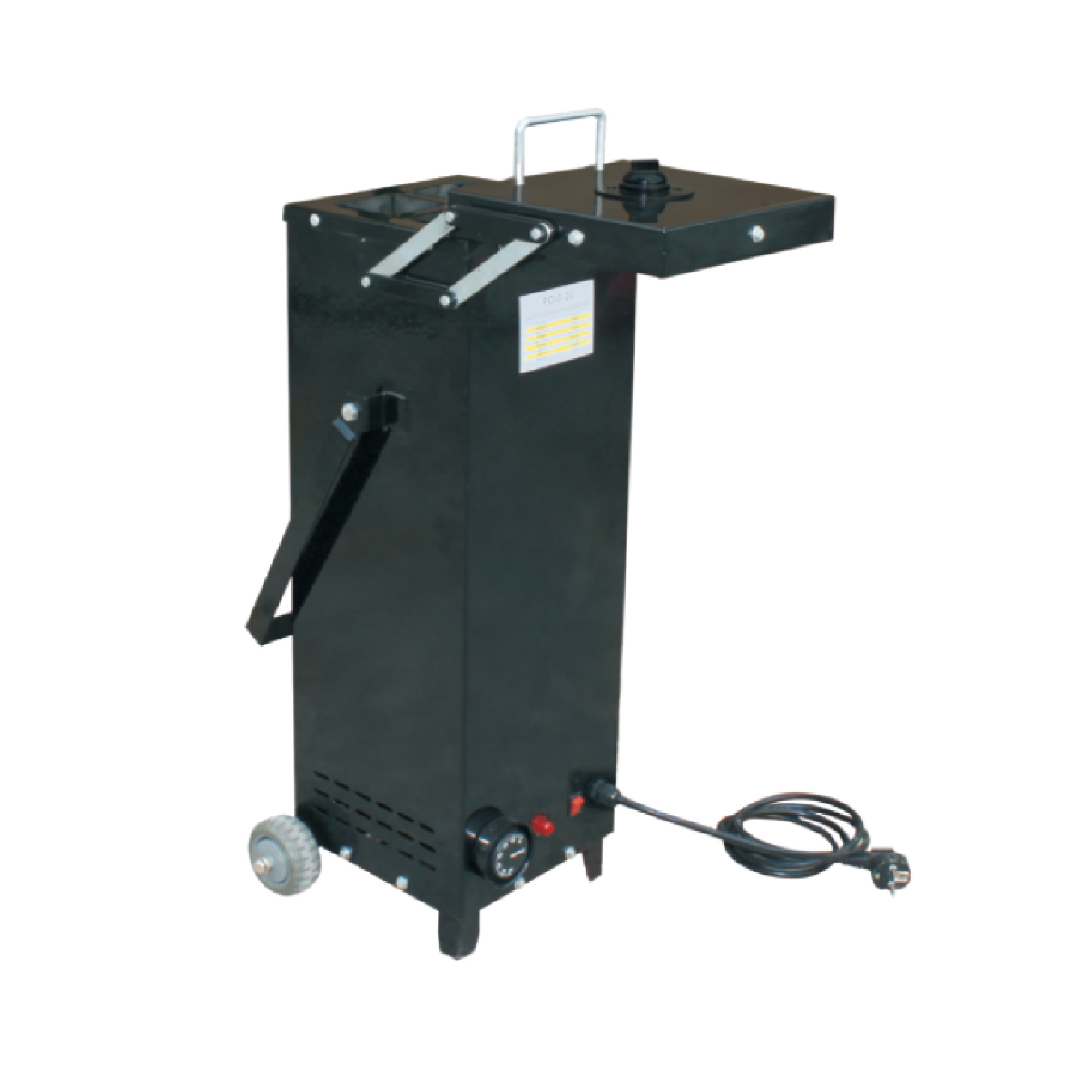
From a purely logistical standpoint, capacity dictates your workflow. Purchasing an undersized unit leads to frustrating bottlenecks as welders wait for fresh rods, while an oversized unit wastes floor space and electrical power.
Mobile units are the absolute workhorses of field operations. Designed to hold between 10 and 20 pounds (roughly 5 to 10 kg) of electrodes, a portable electrode oven is perfect for pipeline crews, mobile repair rigs, and ironworkers bolting up structural steel.
Their defining feature is rugged mobility. They are lightweight, equipped with sturdy carrying handles, and engineered to survive the inevitable drops and bangs of job site transportation. Many of these field models feature AC/DC dual power capabilities, allowing operators to plug them directly into the auxiliary power of an engine-driven welding machine. A 10-to-20-pound capacity generally holds enough consumable material to sustain one welder through a standard shift without requiring a long walk back to the central tool crib.
For small to medium fabrication shops, automotive repair garages, and vocational training schools, bench-top models (holding 50 to 150 lbs) offer the ideal balance. They are stationary but can be relocated with relative ease if shop layouts change. A mid-size unit comfortably supports a team of two to four welders pulling rods continuously throughout the day.
Heavy industrial manufacturing, shipbuilding, and large structural steel fabricators require massive bulk storage solutions. Large floor capacity ovens are engineered to hold anywhere from 400 to over 1000 pounds of welding electrodes. These units serve as permanent fixtures on the shop floor. Due to their sheer size and immense loaded weight, these industrial units are typically built with forklift slots at the base for safe positioning.
In recent years, the fabrication industry has seen a massive shift toward stricter quality assurance and digital traceability. As engineering demands push for higher-strength steels—which are exponentially more susceptible to hydrogen cracking—the tolerance for poor consumable management has completely vanished.
We are seeing a distinct trend where major contractors and auditing bodies are moving away from basic analog dials. Today, modern industrial facilities increasingly demand equipment with integrated data-logging capabilities and programmable Proportional-Integral-Derivative (PID) controllers. This advanced automation allows QA managers to pull historical temperature charts, proving definitively to third-party auditors that a specific batch of rods was maintained within exact code parameters 24/7. Furthermore, the market is trending heavily toward highly insulated, energy-efficient designs that lower power consumption while keeping the exterior shell cool to the touch, drastically improving shop floor safety.
In professional welding environments, particularly those involving structural steel or pressure vessels, thermal management isn't just a best practice—it is strict law. Adherence to standards set by the American Welding Society (AWS D1.1) and the American Society of Mechanical Engineers (ASME Section IX) is mandatory.
The codes outline highly specific parameters for handling low-hydrogen electrodes. Once a hermetically sealed container of E7018 is opened, the rods must immediately go into a holding environment operating at a minimum of 250°F (120°C).
If a rod is removed from that heated environment, a strict "exposure clock" begins. Under standard atmospheric conditions, an E7018 electrode is typically permitted a maximum exposure time of just 4 hours. In environments with high relative humidity, this allowable window shrinks significantly. If the electrode is not consumed in time, it must be returned for a documented rebaking cycle before it can legally touch a structural joint.
Compliance is the absolute foundation of quality assurance. On commercial job sites, third-party Certified Welding Inspectors (CWIs) routinely audit your welding electrode storage practices. They will verify that the equipment is powered on, operating at the correct temperature, and that internal thermometers are properly calibrated. Failure to maintain compliant storage usually results in an inspector issuing a Non-Conformance Report (NCR). This leads to a halt in production, mandatory grinding out of all welds performed with unverified rods, and severe financial penalties.
When evaluating equipment for your facility or mobile rig, looking past basic capacity is critical. You must evaluate the hardware components that dictate the unit's longevity, thermal efficiency, and ability to survive a harsh industrial environment.
The thermostat is the brain of the operation. Analog thermostats utilize a bimetallic strip or capillary tube mechanism to regulate heat. These are highly valued out in the dirt and mud. Because they lack sensitive microprocessors, analog controls are highly resistant to the intense vibrations of a diesel welding rig and airborne grinder dust. However, they typically offer a broader temperature variance (±10°F to ±20°F).
Digital controllers, on the other hand, offer pinpoint accuracy. A digital thermostat uses a thermocouple to monitor internal temps and adjusts the heating elements with precision, often holding the environment within ±2°F of the set point. This level of accuracy is practically mandatory for aerospace, nuclear, and high-pressure vessel fabrication.
Thermal efficiency determines how much energy the unit consumes and how safe it is for operators to brush against. When reviewing specifications, look for units insulated with 1.5 to 2 inches of high-density fiberglass or mineral wool. This ensures that even when the internal core reaches 800°F, the exterior shell remains relatively cool, preventing severe burn hazards.
The internal architecture is a frequently overlooked feature. Simply dumping different types of welding rods into a single, open chamber is a terrible practice that leads to cross-contamination. Internal shelving allows for proper convection airflow, ensuring rods in the center of the pile actually reach the target temperature. Specifically, internal dividers are essential. Storing mild steel E7018s in the same undivided space as 316L stainless steel rods can lead to accidental mixing. If a welder mistakenly grabs the wrong rod from a mixed pile, the resulting weld will suffer from galvanic corrosion and ultimately fail.
Acquiring the right hardware is only the first step. To truly protect your weldments, your team must implement strict standard operating procedures (SOPs) on the floor. Even the most advanced technology cannot compensate for a welder's improper handling.
Inventory management is critical. Welding electrodes do not have an infinite shelf life once removed from their original packaging. To mitigate degradation, fabrication facilities must implement the First-In, First-Out (FIFO) method. Operators should physically separate older rods from fresh ones using the oven's internal dividers. Welders must be explicitly trained to draw from the designated "oldest" section first, preventing a scenario where older rods sit baking at the bottom of the pile for months.
Another crucial aspect is understanding the hard limits of the rebaking process. The chemical flux coating contains specific silicate binders that hold the powdered minerals and alloys to the core wire. Subjecting the rod to extreme redrying temperatures severely stresses these chemical binders.
Industry codes generally stipulate that a heavily exposed electrode can only be rebaked a maximum of one or two times. If baked repeatedly, the silicates will crystallize. The flux will turn brittle and chip off during handling. Therefore, tracking your redrying cycles is mandatory. If rods exceed their atmospheric exposure limit a second time, throw them out. The cost of discarding a few pounds of compromised electrodes is infinitely lower than the labor cost of gouging out a cracked weld.
Choosing the right equipment ultimately depends on your daily consumable consumption, your working environment, and the strictness of the codes you are welding to. You must carefully match your specific temperature requirements, understanding the vast difference between simply holding fresh rods and forcefully rebaking compromised ones.
Investing in a dedicated electrode drying oven protects your overall weld quality, ensures strict regulatory compliance, and saves your business valuable time and money by eliminating rework. Prevent costly defects and maintain your professional reputation by taking moisture control seriously.
Ready to upgrade your shop's quality assurance? Browse the complete catalog of stationary and portable units at Starex Weld today to find the exact capacity and thermal specifications required for your next major fabrication project.
Electrodes should be placed in a holding environment immediately after the factory hermetic seal is broken. The goal of a holding unit (running at 250°F to 300°F) is preventative; it stops the flux from absorbing ambient moisture in the first place. If you leave the rods out on a workbench for several days, they will absorb significant atmospheric water. While they can be dried later, doing so requires a specialized high-temperature rebaking unit (running at 500°F to 800°F). A standard holding unit does not generate enough heat to boil out deeply absorbed moisture. Prevention is always more efficient and safer than restoration.
Yes, over-baking is a serious operational error. Baking electrodes at temperatures higher than the manufacturer's specifications, or leaving them in a high-heat rebaking cycle for too many hours, will permanently destroy the rod. The extreme heat breaks down the chemical binders (sodium or potassium silicates) within the flux. When this happens, the flux becomes excessively dry and brittle, causing it to flake off the core wire during handling or while striking an arc. Always consult the specific filler metal manufacturer's data sheet for exact temperature limits.
Not all filler metals require thermal storage; in fact, some are ruined by it. Cellulosic electrodes, such as E6010 and E6011, are designed with a paper-based flux that explicitly requires a specific moisture content (usually between 3% and 7%) to function. This internal moisture vaporizes during welding to create the necessary shielding gas and the forceful, digging arc characteristic of these rods. Placing cellulosic rods in a heated environment will dry them out completely, resulting in a weak, unstable arc and poor penetration. Additionally, solid MIG wire and bare TIG filler metals lack a flux coating and therefore do not absorb moisture in a way that requires thermal management.
Using a kitchen appliance for industrial welding rods is both ineffective and highly dangerous. Household appliances lack the heavy-duty insulation, precise temperature PID controllers, and specific ventilation systems required to consistently and safely bake out industrial moisture. More importantly, it is a severe health hazard. The flux on welding electrodes contains complex industrial chemicals, metallic powders, and silicates. Heating these materials releases fumes and chemical off-gassing that will contaminate the interior of the appliance. Baking industrial filler metals in the same environment used for food preparation poses a direct toxicological risk to human health.