
Views: 0 Author: Site Editor Publish Time: 2026-09-30 Origin: Site


Did you know a split-second arc flash causes irreversible eye damage? If you have spent any time under a hood, you already know the physical toll of the trade. Old passive shields cause severe neck fatigue. The constant nodding motion often ruins your weld starts before the puddle even forms. Modern fabrication demands better.
Today, we are looking at how advanced headgear solves these physical and operational bottlenecks. We will break down shade variations, sensor technology, and the non-negotiable safety features that protect your vision—and your livelihood.
Instant Adaptation: Modern electronic lenses transition the millisecond an arc is struck. This eliminates eye strain and dramatically boosts daily arc-on time.
Sensor Redundancy: The number of arc detectors dictates reliability. Four-sensor setups are critical for out-of-position pipe or chassis work.
Process Versatility: Variable shade controls let you jump from high-amp structural flux-core to low-amp precision TIG without changing hoods.
Certified Defense: Industrial-grade gear must meet strict ANSI Z87.1 or EN379 standards. This guarantees permanent ultraviolet (UV) and infrared (IR) protection.
Optical Precision: Top-tier optical clarity (1/1/1/1) and rapid reaction speeds separate professional investments from cheap budget buys.
An auto darkening helmet is a highly specialized piece of personal protective equipment. It is engineered to shield your eyes and face from intense radiation, sparks, and molten spatter. Unlike old-school fixed-shade shields, it utilizes an electronic liquid crystal display (LCD). This screen darkens automatically in a fraction of a millisecond the exact moment you strike an arc.
The core of this protection relies on a sophisticated module. Several specialized layers work together instantly. A passive UV/IR interference filter sits at the front. It continuously blocks invisible, tissue-damaging radiation. This barrier works whether the helmet is turned on or completely dead.
Sandwiched behind this are multiple polarization filters and liquid crystals. When light-sensitive photo-detectors on the front cartridge detect an intense flash, they send an electrical signal. The liquid crystals immediately twist. This action chokes off the visible light allowed through to your eyes.
Understanding the gap between passive and electronic models is your first step in upgrading. Passive hoods use a fixed dark piece of glass, usually Shade 10. To use one, you have to physically nod your head to drop the hood just before striking the metal. Doing this hundreds of times a day wrecks your cervical spine.
In contrast, electronic alternatives give you total hands-free operation. You get a continuous, clear view of your workpiece before ignition. No more blind electrode placement. You hit the joint perfectly every time, which drastically cuts down on post-weld grinding and scrap rates.
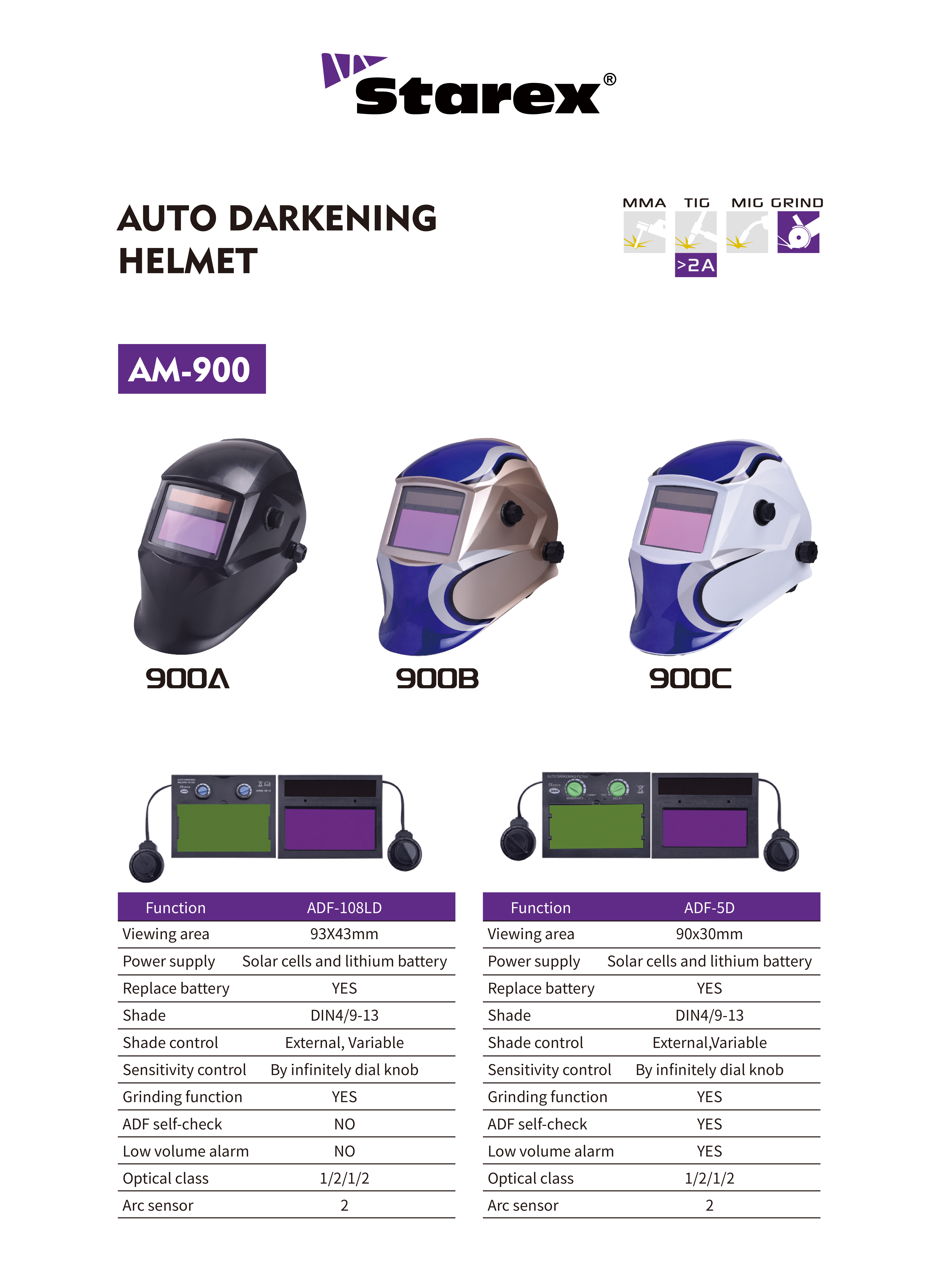
When you are evaluating protective gear, you must look past the flashy exterior graphics. The internal hardware dictates performance on the shop floor. Here is what actually matters when the sparks start flying.
The reliability of your lens depends entirely on its arc sensors. Helmets with two sensors are fine for garage hobbyists or basic flat bench work. But what happens when you are welding in a cramped pipe rack? If your own hand or a torch nozzle blocks the line of sight between a two-sensor setup and the arc, you will get flashed.
Professional-grade models, like the Starex AM-900 series, feature four independent sensors. This provides the necessary redundancy. Even if two sensors are physically obstructed, the remaining detectors ensure the lens darkens instantly.
Switching speed is the fraction of a second it takes for the lens to go from light to dark. Standard entry-level units usually react in 1/10,000 of a second. That is fast enough to stop acute arc flash. However, repeated exposure to that tiny micro-flash over a ten-hour shift causes severe eye fatigue.
If you weld for a living, you need premium switching speeds. Look for reaction times of 1/25,000 or even 1/30,000 of a second. This virtually eliminates visual strain, keeping you sharp until clock-out.
Your visual experience is defined by the window size and the glass quality. A standard 3.5" x 1.5" viewing area feels like looking through a mail slot. Upgrading to a panoramic screen—such as a massive 3.94" x 3.66" (100x93mm) window—gives you superior peripheral vision. This is crucial for spatial awareness in busy fabrication shops.
Furthermore, optical clarity is your window to the weld puddle. The EN379 standard evaluates this across four categories. A top-tier 1/1/1/1 rated lens provides pristine, high-definition vision. There is no distortion, no haziness, and no inconsistent shading across the glass.
Feature Comparison | Auto-Darkening Technology | Traditional Passive Hoods |
|---|---|---|
Productivity | High (No nodding, precise arc starts) | Low (Constant lifting and nodding) |
Ergonomics | Excellent (Prevents repetitive neck strain) | Poor (High risk of cervical fatigue) |
Versatility | Variable shades (DIN 5-9 / 9-13) for all processes | Fixed shade (Requires swapping glass plates) |
Weld Quality | Fewer bad starts, less grinding required | Higher risk of arc strikes outside the joint |
Selecting the correct shade level is not just about comfort; it is a fundamental safety requirement. Different processes emit vastly different light intensities. Adaptability is non-negotiable for modern fabricators.
Historically, welders relied on fixed-shade glass. This severely limits what you can do. Imagine switching from heavy 300-amp flux-core to delicate 30-amp TIG work. A fixed Shade 10 will either blind you or leave you staring into a black void.
This is exactly where an adjustable shade welding helmet proves its worth. Advanced digital controls let you seamlessly transition between multiple darkness levels. Premium units offer a dual-range setup, typically DIN 5-9 for plasma cutting or low-amp TIG, and DIN 9-13 for standard structural welding. You always get the perfect view of the puddle without risking retinal burns.
Beyond standard shading, auxiliary functions make or break a helmet's usability. Engaging "Grind Mode" electronically locks the lens into a light state (usually Shade 3.5 or 4). You can grab your angle grinder for material prep without the shower of sparks triggering the sensors into a strobe-light effect.
Additionally, sensitivity controls let you dial in the activation threshold. High sensitivity is vital for low-amp TIG where the arc is faint. Low sensitivity stops the lens from flickering when you are welding outdoors in direct sunlight.
Subjective comfort should never override objective safety. The primary job of your headgear is to stop irreversible damage from radiation, extreme heat, and high-velocity debris.
There is a persistent myth on job sites: if your helmet battery dies mid-weld, you will get welder's flash. This is scientifically false when using certified gear. The auto darkening filter contains a permanent, physical interference layer.
This specific layer is engineered to block 100% of harmful UV and IR radiation at all times. Even if the electronics fail completely, the invisible, tissue-damaging rays cannot penetrate the glass. The electronic LCD only manages intense visible light to prevent temporary blindness.
Never trust your eyesight to unverified equipment. In the United States, the ANSI Z87.1 standard ensures the shell and lens can withstand high-mass and high-velocity impacts. It protects your face from shattered grinding discs or flying slag. Similarly, CE EN379 in Europe dictates strict criteria for optical clarity and heat tolerance. Always check the inside of the shell for these stamped certifications.
Technical specs mean nothing if the hood is too painful to wear. When you are eight hours into a shift, the physical ergonomics of your welding safety helmet directly impact your musculoskeletal health.
The human neck is highly susceptible to fatigue under unbalanced loads. Heavy, outdated hoods shift your center of gravity forward. This creates a cantilever effect, forcing your posterior neck muscles to stay tense all day.
Modern engineering solves this. By utilizing lightweight, high-impact nylon blends, manufacturers keep the weight down. The shell sits closer to your face, bringing the center of gravity inward and drastically reducing torque on your cervical spine.
The internal harness is the only thing touching your head. Cheap entry-level gear uses a stiff, single-strap ratchet. Professional suspension systems incorporate multi-point adjustability. This distributes pressure evenly across your cranium, eliminating pressure headaches. You can also adjust the distance from your eyes to the lens, which is a lifesaver if you wear prescription glasses or a half-mask respirator.
The occupational safety sector is undergoing a massive technological shift. The biggest game-changer right now is the universal demand for "True Color" optics. Older helmets forced you to view your work through a murky green tint. Today, advanced liquid crystal technology allows you to see the weld puddle, the heat-affected zone, and the base metal in natural, high-definition hues. This color accuracy drastically improves precision.
Furthermore, we are seeing a push toward smart integration. As industries like aerospace and EV manufacturing demand tighter tolerances, welding PPE is evolving. Features like digital interfaces that track arc-on time and ultra-heat-resistant polymer blends are becoming the new baseline for industrial fabrication.
Navigating the market requires a logical approach. Do not just buy the most expensive option; buy the tool that matches your daily reality.
1. Assess Your Primary Process: If you exclusively run high-amp MIG on structural steel, a durable unit with a 9-13 shade range works perfectly. However, if you do precision TIG on thin stainless or titanium, you must prioritize a 1/1/1/1 optical rating, four sensors, and a low shade range (down to DIN 5).
2. Evaluate Your Environment: Indoor shops are controlled. Outdoor structural work is not. If you weld outside, you need advanced sensitivity controls to stop sunlight from false-triggering the lens. For confined space work, look for a low-profile shell design to prevent banging your head against pipe racks.
3. Check Consumable Availability: Spatter will eventually pit your outer cover lenses. Sweatbands get ruined. Before buying, verify that replacement cover plates and batteries are cheap and easy to source. A great helmet is useless if you cannot buy replacement clear shields for it.
Yes, they are exceptionally safe when manufactured to industrial standards. High-quality models utilize a permanent, passive interference filter built directly into the cartridge. This blocks 100% of harmful UV and IR radiation at all times, even if the battery dies or the lens is in its light state.
The physical nylon shell can last a decade. The electronic filter module typically has a functional lifespan of 5 to 7 years. This depends on usage frequency, storage temperatures, and maintenance. Changing the batteries regularly and keeping the sensors clean maximizes this lifespan.
You do not need to strike an arc to test it. Put the helmet on and look at a bright light bulb, then quickly pass your hand in front of the sensors. Alternatively, use a standard TV remote control; point the infrared LED at the helmet sensors and press a button. The rapid flashing of the remote will trigger the lens to darken instantly.
Experiencing a bright flash is usually a sensor issue. First, check if heavy spatter is physically blocking the arc sensors on the front cover lens. Second, your sensitivity setting might be too low for the current lighting. Finally, a dying battery can cause a delayed reaction time. Swap the cover lens, turn up the sensitivity, and check the power.
It is the highest possible rating under the EN379 standard. The four numbers grade: Optical class (distortion), Light diffusion (haziness), Luminous transmittance (consistent shading across the lens), and Angle dependence (does the shade change if you look through the corner of the glass). A 1/1/1/1 rating means perfect, high-definition vision without eye strain.
Yes, but only if the unit features a dedicated "Grind Mode." This setting electronically locks the lens into a light state (Shade 3.5 or 4) and disables the arc sensors. This allows you to safely grind without sparks causing the screen to violently flicker dark and light.
Investing in professional-grade protective gear is a direct investment in your craftsmanship and your health. Outdated passive shields drain your energy and slow down your production. By prioritizing four-sensor reliability, True Color optical clarity, and proper ergonomic weight distribution, you eliminate the physical strain of fabrication.
Stop fighting your equipment and start focusing on the puddle. If you are ready to upgrade your daily welding experience, evaluate your specific process needs and choose a helmet built for the reality of industrial work. Explore our complete lineup of professional-grade headgear at Starex Weld to find the exact specifications your shop demands.