
Views: 0 Author: Site Editor Publish Time: 2026-09-23 Origin: Site


You are halfway through cutting a heavy 2-inch steel plate. Suddenly, a violent, concussive "crack" echoes across the shop floor. Did you know that without the right safety devices in place, a reverse flow of mixed gases can turn your cylinders into a bomb?
Most veteran welders know the extreme dangers of oxy-fuel operations. Yet, picking the correct safety gear still causes widespread confusion. Navigating through different gas compatibilities, pressure drops, and thread sizes is enough to make anyone's head spin. As the ultimate line of defense against catastrophic accidents, a reliable safety setup is non-negotiable.
In this engineering guide, we will break down exactly how to spec out the right equipment for your shop. We will look at real-world parameters, compare mounting locations, and help you build a fail-safe system that keeps your crew alive and your production running.
Location Dictates Function: Your choice between torch-mounted and regulator-mounted devices depends on hose length and operator mobility. Heavy industrial setups often demand both.
More Than a Check Valve: A true arrestor stops reverse gas flow and kills the flame. A standard check valve will simply melt during a fire.
Strict Gas Compatibility: Oxygen and fuel devices have different internal seals, threads, and color codes. They are never interchangeable.
Flow Rate Matters: Undersizing your safety gear starves the torch tip. Ironically, this low gas velocity actually increases the risk of backfires.
Hard Expiration Dates: These are not lifetime parts. Mechanical springs fatigue and filters clog. Industry standards require replacement every 3 to 5 years.
Controlling volatile gases on a fabrication floor comes down to strict physics. A flashback arrestor is a specialized mechanical barrier designed to stop a flame from traveling backward down your hoses and breaching the pressurized cylinders. Without this piece of oxy fuel safety equipment, a simple spark in a mixed-gas hose can ignite instantly. The result? Devastating property damage and severe injuries.
To understand why this component is so critical, look inside its solid brass casing. A premium unit relies on two specific mechanisms working together.
First is the flame arrestor. This is usually a highly porous, sintered stainless steel cylinder. When a supersonic flame front hits this barrier, the fire is forced through microscopic metal pores. The massive surface area of the stainless steel rapidly absorbs the heat, dropping the flame below its ignition temperature and snuffing it out in milliseconds.
Second is the check valve. This precision spring-loaded mechanism stops the initial reverse flow of gases. As long as gas flows in the correct direction, the pressure holds the valve open. If downstream pressure spikes unexpectedly, the spring snaps the valve shut, isolating your gas supply before the fire even starts.
A scary trend in many smaller shops is treating check valves and flashback arrestors as the same thing. Let's clear the air right now. A non-return valve strictly stops gas flow. It does nothing to stop a fire.
If a spark has already ignited a volatile mixture inside your hose, the concussive pressure wave will blow a simple check valve to pieces. A true flashback arrestor combines the check valve with the sintered metal filter to extinguish the actual fire. Relying only on a check valve leaves your operators completely exposed.
To make smart equipment choices, you need to know what kind of combustion anomaly you are dealing with. Safety guidelines draw a hard line between a backfire and a flashback.
A backfire happens when the flame momentarily burns back into the torch tip. You will hear a loud "pop" or "bang." After the pop, the flame might go out entirely, or it might reignite at the tip.
What causes it? Usually, it's operator error. Touching the cutting tip to the steel, overheating the torch during a long cut, or running the wrong regulator pressures are common culprits. While alarming, a backfire rarely damages equipment beyond the copper tip. However, if your torch is constantly backfiring, take it as a warning sign. A bigger problem is brewing.
A flashback is a high-velocity emergency. The flame recedes past the torch tip, travels through the handle, and shoots directly into the gas hoses. This flame front can reach supersonic speeds.
If that fire reaches the cylinders, the resulting explosion is catastrophic. Flashbacks are often eerily silent after that initial pop, though you might hear a high-pitched squealing sound as the fire actively burns inside the rubber hose. This exact scenario is what flashback arrestors are engineered to stop.
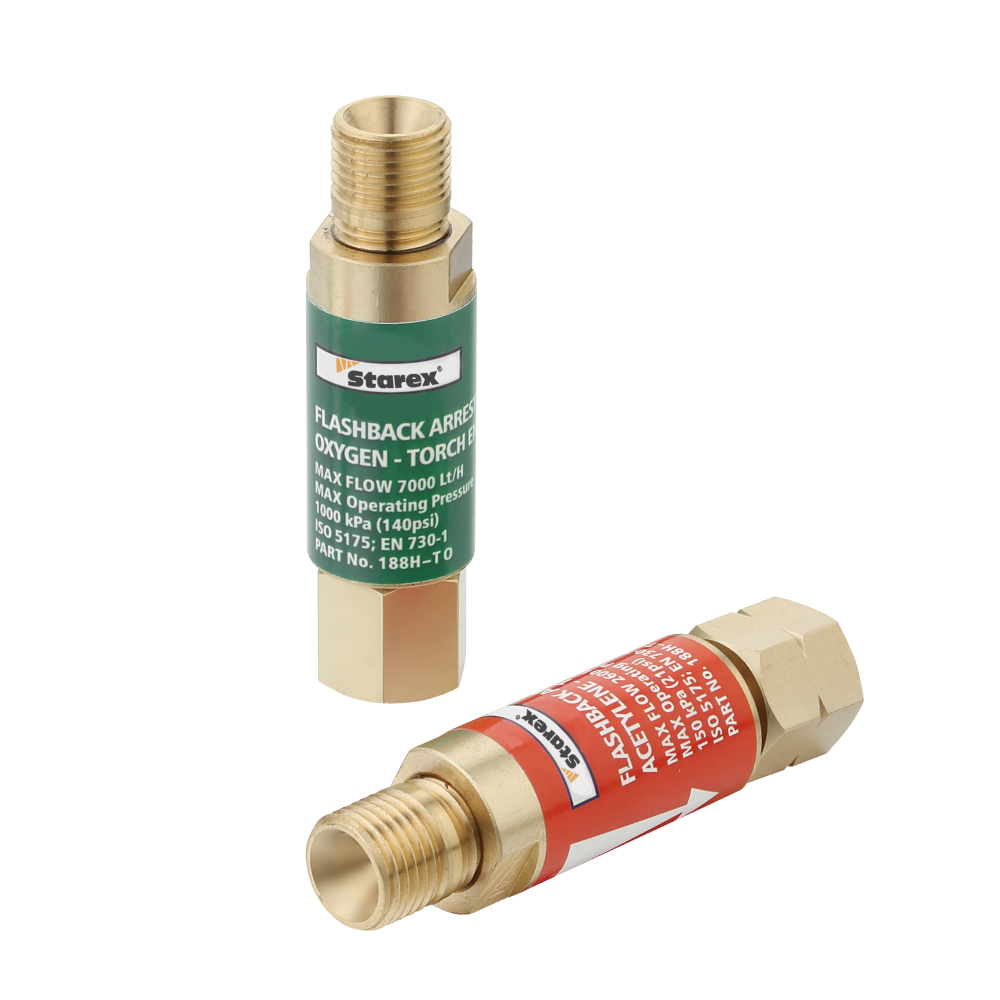
Deciding where to install your safety gear is a balancing act between operator ergonomics and maximum system protection. Let's look at the operational differences.
A torch flashback arrestor threads directly into the base of the torch handle. The biggest advantage here is immediate reaction time. If a flashback triggers, it is killed at the source. The fire never enters the hoses, preventing a dangerous hose blowout.
The downside? You are adding solid brass weight to the base of the torch. For a welder doing precise, out-of-position pipe welding all day, that extra bulk shifts the balance and causes wrist fatigue.
On the other hand, a regulator flashback arrestor installs at the output valves back at the cylinders. This keeps the torch lightweight and easy to maneuver.
The trade-off is hose vulnerability. Because the safety device is 20 or 50 feet away, a flashback will travel the entire length of the hose before it hits the arrestor. Your cylinders will survive, but your hoses will be hollowed out by internal fire and must be thrown in the trash.
Feature | Torch-Mounted | Regulator-Mounted |
|---|---|---|
Primary Protection | Protects both hoses and cylinders | Protects cylinders only |
Operator Ergonomics | Adds weight to the torch handle | Keeps torch lightweight |
Hose Damage Risk | Low (Stops fire at the source) | High (Fire travels through hose) |
Best For | Short hoses, precision welding | Long hose runs, heavy cutting |
Pro Tip: For heavy industrial sites with hose runs over 15 feet, safety engineers strongly recommend using both. Redundant protection is always the smartest play, provided your regulators can handle the pressure drop.
If you look at recent safety audits across major fabrication facilities, there is a clear trend emerging. Facility managers are actively tearing out cheap, uncertified brass fittings and replacing them with high-tier, automated safety components.
Why the sudden shift? Regulatory bodies like OSHA and ISO are tightening their grip. The liability costs of a workplace explosion far outweigh the price of premium gear. Today's market is moving heavily toward arrestors featuring integrated thermal cut-off valves. If a fire burns continuously against the internal filter, a fusible link melts at around 200°F (93°C). This automatically snaps a secondary valve shut, permanently cutting off the gas supply. It takes the human reaction element completely out of the equation.
Buying safety gear isn't about grabbing the cheapest option off the shelf. You need to match the technical specifications to your specific cutting or welding application. Here is exactly what you need to look for.
Oxygen and fuel gases have vastly different molecular weights and ignition points. Equipment must never be mixed.
Look at industry-standard equipment like the 188-Series. Oxygen models are color-coded blue or green, featuring standard right-hand threads, and are engineered to handle a maximum working pressure of about 1.5 MPa (210 PSI).
Fuel gas models (for Acetylene, Propane, or Natural Gas) are red. They use left-hand threads—marked by a notch on the hex nut—so you physically cannot attach them to an oxygen line. Acetylene models are strictly capped at a max working pressure of 0.15 MPa (21 PSI) due to the gas's extreme instability.
A mismatched thread means a leaky system. Before you order, check your current torch and regulator fittings. In North America, the standard industrial size is the "B" fitting, which uses a 9/16"-18 thread. In many international or European setups, you will see metric M16x1.5 threads. Buy the exact match. Using brass adapters just adds unnecessary connection points that can leak.
Every sintered filter creates physical resistance. If you put a low-flow arrestor on a heavy-duty rosebud heating tip, you will starve the torch. When gas velocity drops too low, the flame naturally wants to burn backward into the tip. Always check the manufacturer's flow chart. You will likely need to bump up your regulator pressure by a few PSI to compensate for the restriction.
Even premium safety devices fail if installed poorly. Avoid these common shop floor mistakes.
Installing Them Backwards: It sounds silly, but it happens daily. Check valves are directional. Look for the highly visible flow arrows stamped on the brass casing. For torch-mounted units, the arrow points toward the tip. For regulator-mounted units, the arrow points down the hose.
Ignoring Propane vs. Acetylene Specs: Don't assume all fuel gases are the same. Acetylene runs at very low pressures. Propane (LPG) is often cranked up high for heavy steel heating. Using a low-pressure acetylene arrestor on a high-pressure propane rig can blow out the internal seals. Verify your specific gas type on the certification label.
Industrial environments are brutal on brass equipment. Temperature swings, physical drops, and continuous pressure take their toll.
Make testing part of your daily routine. Do a visual check for deep gouges or heat discoloration. Every time you swap cylinders, use an oil-free leak detector on the threads. Watch your flame quality; a sudden drop in gas flow usually means the internal filter is clogged with carbon.
When do you throw them away? If a flashback actually occurs, replace the arrestors immediately. The extreme heat compromises the sintered filter. Even without an accident, mechanical springs fatigue over time. Replace them proactively every 3 to 5 years, no matter how shiny they look on the outside.
Oxy-fuel safety comes down to understanding the physics of your equipment. Whether you choose a torch-mounted setup for maneuverability or a regulator-mounted system to protect your cylinders, the goal remains the same: stop the flame before it causes a disaster.
Don't wait for a concussive pop to audit your shop's safety gear. Check the expiration dates on your current setup, verify your thread sizes, and ensure your flow rates match your cutting tips. If it is time to upgrade, invest in certified, heavy-duty protection. Explore the full range of professional-grade safety solutions at Starex Weld to find the exact specifications your application demands.
Yes. Flashbacks can occur in both the fuel gas and oxygen lines. You must install a dedicated, gas-specific arrestor on both lines to ensure complete system protection. If a reverse flow condition forces mixed gases into either line, an ignition can travel up whichever hose contains the volatile mixture.
Yes, the internal flame arrestor filter creates a slight pressure drop due to physical resistance. You may need to slightly increase your regulator pressure to compensate, according to the manufacturer's flow charts, to prevent gas starvation at the torch tip.
A check valve (non-return valve) only stops gas from flowing backward; it cannot stop a fire. A flashback arrestor contains a check valve plus a sintered metal filter that physically cools and extinguishes an actual supersonic flame front.
Standard inline flashback arrestors cannot be reset and must be replaced immediately after stopping a flashback. While some heavy-duty industrial models for large manifold systems have resettable levers, standard portable torch arrestors are single-use protection devices in the event of a fire.
They can be installed at the torch handle, at the regulators, or both. Torch-mounted devices stop the flame before it enters and destroys the hoses. Regulator-mounted devices protect the gas cylinders. For maximum safety on long hose runs, using both is highly recommended.
The most common sign of a bad or clogged arrestor is a sudden, unexplainable drop in gas flow at the torch tip, resulting in a weak or unstable flame. If adjusting the regulator pressure doesn't fix the flow, the internal sintered filter is likely clogged with carbon deposits and the unit must be replaced.
Due to the highly unstable nature of acetylene gas, safety regulations strictly cap its maximum working pressure at 15 PSI (approximately 0.1 MPa). Acetylene flashback arrestors are engineered specifically for this low-pressure threshold and should never be subjected to higher pressures.