
Views: 0 Author: Site Editor Publish Time: 2026-09-14 Origin: Site


As steel plate thickness increases, the thermodynamic requirements and fluid dynamics of the oxygen stream change exponentially. The physical reality of thermal cutting dictates that pushing a standard setup beyond its designed capacity inevitably compromises the cut. Applying a one-size-fits-all approach to equipment selection results in excessive slag accumulation, wide kerfs, severe top-edge melting, and wasted consumable gases. These inefficiencies directly translate to increased secondary machining requirements and unnecessary operational delays.
Selecting the correct cutting torch and cutting nozzle requires a systematic evaluation of material thickness, gas flow capacity, and fuel type. A proper configuration ensures precision, maintains safety standards, and optimizes gas consumption. By understanding how the physical dimensions of the steel interact with the preheat flame and oxygen jet, operators can configure their gas cutting systems to handle anything from thin sheet metal to massive steel blocks without sacrificing quality.
Bore Diameter is Non-Negotiable: The cutting oxygen bore size must scale directly with plate thickness to maintain the correct oxygen jet velocity for effective slag evacuation.
Flow Capacity Dictates Torch Selection: Heavy-duty cutting torches with larger internal gas passages are mandatory for plates exceeding 100mm (4 inches) to prevent flow starvation.
Fuel Gas Drives Nozzle Design: The choice between acetylene (one-piece nozzles) and alternative fuels like propane or natural gas (two-piece nozzles) fundamentally alters preheat times and equipment selection for thick plates.
Angled Cuts Increase Effective Thickness: When beveling, the cutting path is longer than the nominal plate thickness, requiring a corresponding step-up in cutting nozzle size.
Safety Scales with Thickness: Cutting thicker materials increases the risk of sustained backfires; equipment must be rated for the specific gas pressures and volumes required.
Thermal cutting relies on raising carbon steel to its ignition temperature, approximately 870°C (1600°F). At this temperature, the steel rapidly oxidizes when exposed to a pure oxygen stream. Achieving and maintaining this localized temperature becomes significantly more difficult as plate thickness increases. Thicker plates act as massive heat sinks, rapidly drawing thermal energy away from the cut zone and dissipating it throughout the surrounding metal.
To counter this rapid heat loss, operators must utilize equipment with higher preheat capacities. Initiating and maintaining the exothermic reaction on a 150mm plate requires a massive, sustained thermal input compared to a 10mm plate. If the preheat flame is oversized for thin plates, the excess heat causes severe top-edge rounding and distortion. If the preheat is undersized for thick plates, the cut will frequently fail, as the steel drops below its ignition temperature before the oxygen jet can fully penetrate the material.
The cutting oxygen stream serves two functions: it chemically oxidizes the heated steel and physically blows the resulting molten slag through the kerf. As the oxygen reacts with the iron, it generates additional heat that sustains the process through the entire depth of the cut. Maintaining the coherence of this oxygen jet is paramount for a clean, straight cut.
Increased plate thickness demands a larger volume of oxygen delivered at a specific pressure to maintain jet coherence all the way to the bottom of the cut. If the jet loses its shape or velocity prematurely, the slag will freeze near the bottom edge, creating a messy, difficult-to-remove dross. The fluid dynamics of the oxygen stream must remain laminar. Introducing excessive pressure through a small orifice creates turbulence, which scatters the jet and destroys the vertical profile of the kerf.
Performing bevel cuts introduces a significant geometrical change to the cutting process. When cutting at an angle, the actual distance the oxygen jet must travel through the metal increases substantially compared to a straight vertical cut. Operators must account for this increased distance to maintain cut quality and penetration.
The mathematical reality of beveling is straightforward. Applying a 45-degree bevel on a 50mm plate increases the effective thickness the jet must penetrate to over 70mm. The standard rule of thumb in the field requires adjusting the equipment size and gas flow settings based on this effective, angled thickness rather than the nominal vertical plate thickness. Failing to step up the equipment size for heavy bevels results in incomplete penetration and severe slag buildup on the lower edge.
Not all torches are manufactured to handle the extreme gas volumes required for heavy plate processing. Equipment is generally categorized into standard-duty, medium-duty, and heavy-duty classifications based on internal tube diameters and valve flow coefficients (Cv). These internal dimensions dictate the maximum volume of gas the tool can deliver without causing a restrictive bottleneck.
A threshold exists around the 75-100mm (3-4 inches) mark. Beyond this thickness, standard and medium-duty torches begin to experience gas starvation. The internal passages simply cannot flow enough oxygen to maintain the required jet velocity at the nozzle exit. This starvation leads to severe pressure drops, unstable flames, and inevitable cut loss. For heavy plate applications, upgrading to a heavy-duty cutting torch with enlarged gas tubes is a strict operational requirement.
The method by which oxygen and fuel gas are mixed inside the equipment plays a major role in performance and safety, especially at high flow rates. Equal-pressure (positive pressure) mixers require both the oxygen and fuel gas to enter the mixing chamber at roughly the same pressure. These are highly effective when high-pressure fuel gas is readily available from cylinders or bulk tanks.
Injector (low-pressure) mixers utilize the high-velocity oxygen stream to create a venturi effect, physically pulling the fuel gas into the mixing chamber. This mechanism is necessary when utilizing low-pressure fuel sources, such as natural gas lines. When scaling up to the massive gas volumes required for cutting sections exceeding 150mm, injector mixers often provide superior flame stability and safety, as they actively prevent the high-pressure oxygen from backing up into the fuel line during heavy operations.
The physical geometry of the tool directly impacts operator ergonomics and cut control. Common head angles include 90-degree, 75-degree, and straight configurations. The choice of angle depends entirely on the cutting position and the physical environment of the workpiece.
When dealing with the extreme radiant heat generated by thick plate cutting, maintaining a consistent standoff distance is critical. A 90-degree or 75-degree head allows the operator to comfortably rest their hands or a guide wheel on the plate surface while keeping their body away from the direct heat zone. Straight configurations are primarily reserved for mechanized setups or specific scrap cutting scenarios where the operator must reach deep into confined spaces.
Manufacturer tip charts are based on strict fluid dynamic engineering. Larger cutting oxygen bores allow higher flow rates to pass through the orifice without requiring excessive, turbulent pressures. The goal is to deliver a massive volume of oxygen in a smooth, coherent column.
Using a small bore at high pressure in an attempt to cut thick steel results in a highly turbulent jet. This turbulence creates a bell-mouthed kerf, where the cut widens unpredictably beneath the surface, and often fails to clear the slag at the bottom. Conversely, using a large bore at low pressure on thin material results in insufficient velocity to blow the molten metal away, causing the slag to simply fuse back together behind the cut. Matching the bore diameter to the exact plate thickness is the only way to ensure the correct balance of volume and velocity.
The physical construction of the consumable tip must match the specific burning characteristics of the fuel gas being used. The industry relies on two distinct designs to accommodate these differences safely and efficiently.
Nozzle Type | Construction | Fuel Gas Compatibility | Design Rationale |
|---|---|---|---|
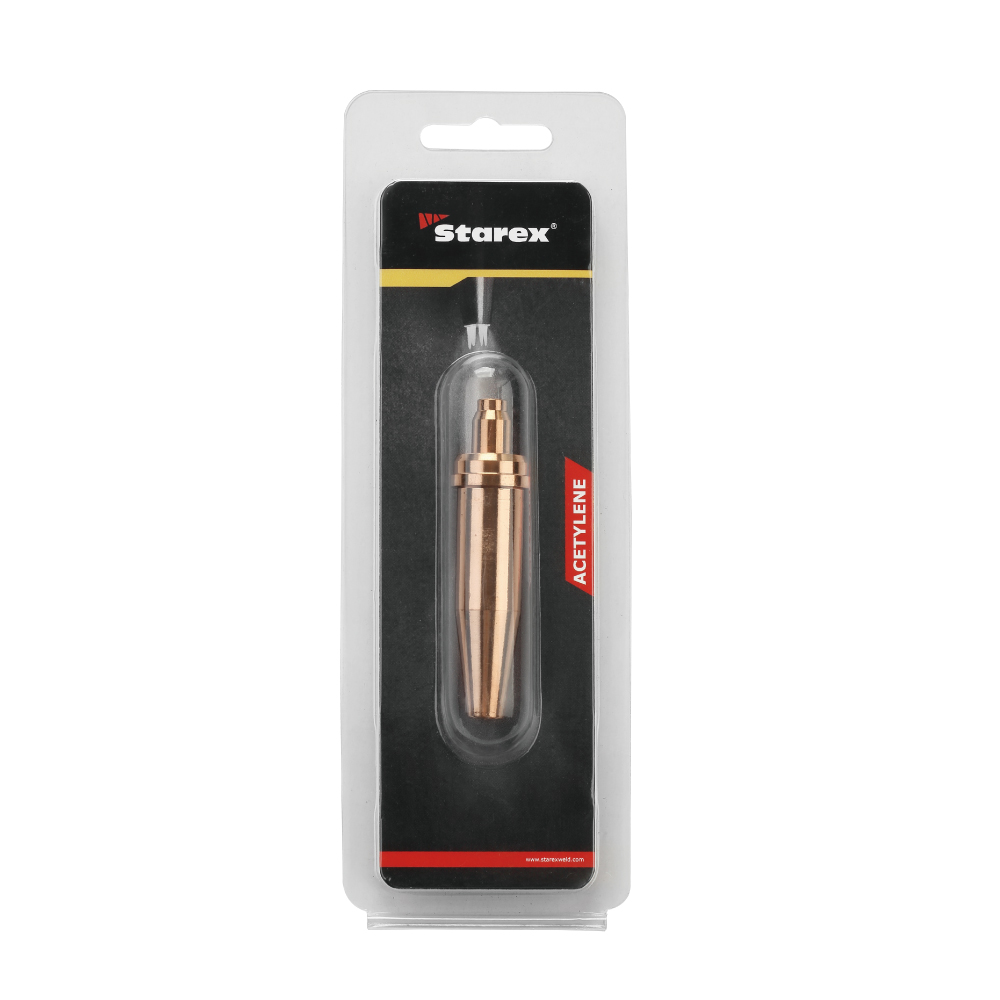
One-Piece | Solid copper with precision drilled orifices. | Acetylene | Acetylene has an extremely fast burning velocity. The flat face of a one-piece design prevents the flame from burning back inside the tip. |
Two-Piece | Inner brass/copper spline with an outer copper shell. | Propane, Natural Gas, Propylene | Alternative fuels burn much slower. The recessed design anchors the flame, preventing the high-velocity oxygen from blowing the preheat flame out. |
Selecting the wrong construction type for your fuel gas will result in constant flame blowouts or dangerous sustained backfires. A cutting nozzle must be engineered specifically for the thermodynamics of the gas flowing through it.
The choice of fuel gas dictates the preheat time, the specific equipment required, and the overall efficiency of the operation. Acetylene provides the highest flame temperature, making it exceptional for fast preheating on thin-to-medium plates. However, its lower total heat release (BTU) makes it less effective at penetrating the massive heat sinks of extremely thick plates.
Alternative fuels like propane and natural gas offer a higher total heat release, providing the sustained thermal energy required to keep thick plates at ignition temperature. For extreme thicknesses ranging from 150mm to over 300mm, liquid hydrocarbon fuel alternatives, such as gasoline/oxy-fuel systems, are often deployed. Liquid fuel vaporization offers superior localized energy density compared to standard gaseous fuels, driving intense heat deep into the kerf and preventing the cut from quenching.
Operators must account for the exponential increase in oxygen consumption as plate thickness and bore size increase. Cutting a 100mm plate does not simply use twice the oxygen of a 50mm plate; the volume required scales dramatically to maintain the necessary jet coherence and slag evacuation velocity over the longer vertical distance.
Understanding these consumption rates is vital for calculating the operational expenses of a project. While using a larger tip consumes more gas per minute, it often completes the cut significantly faster and cleaner than an undersized tip struggling through the material. The labor and time savings gained by using the correct, larger tip size almost always offset the increased consumable gas costs, while simultaneously reducing the need for post-cut grinding.
There is a direct, inverse relationship between travel speed and plate thickness. As the material gets thicker, the operator must slow down to allow the oxygen jet sufficient time to oxidize the steel and clear the deep kerf. Pushing the travel speed too high on thick plates causes the cut stream to drag backward, eventually failing to penetrate the bottom edge.
To optimize speed without sacrificing quality on thicker materials, operators can utilize high-speed divergent tips. These specialized consumables feature an internal taper that expands the oxygen jet, accelerating it to supersonic velocities. This advanced fluid dynamic design improves both the cut quality and the maximum travel speed on heavy plates compared to standard cylindrical bore designs.
High-volume, high-pressure operations on thick plates significantly increase the severity and frequency of backfires. When piercing heavy plate or encountering internal inclusions, molten slag can easily pop back into the tip orifices. In high-flow scenarios, this disruption can force the mixed gases to ignite inside the equipment.
To mitigate this risk, high-flow flashback arrestors and heavy-duty check valves are mandatory. Standard arrestors often restrict gas flow, causing the very starvation issues operators are trying to avoid. Therefore, the safety equipment must be explicitly rated for the high flow volumes demanded by heavy plate operations, ensuring protection without compromising performance.
Manual operations on thick plates exact a heavy physical toll on the operator. The intense radiant heat, combined with the extremely slow travel speeds required for thick steel, makes it difficult to maintain a steady hand and consistent standoff distance over long cuts. Fatigue directly translates to poor cut quality, gouging, and lost penetration.
When processing plates thicker than 75mm over long distances, transitioning from manual tools to mechanized solutions becomes highly advantageous. Utilizing a mechanized straight-line tractor or a CNC oxy-fuel setup removes the human element of fatigue. These systems maintain a perfectly consistent travel speed and standoff distance, ensuring a smooth, high-quality cut while keeping the operator safely away from the intense thermal zone.
Successful gas cutting is an exercise in fluid dynamics and applied thermodynamics. The equipment must deliver the necessary volume of gas, and the consumables must shape that volume to perfectly match the physical dimensions of the steel plate. Ignoring these physical realities leads to poor quality, wasted resources, and unsafe working conditions.
To ensure optimal results, follow these next steps:
Audit the maximum plate thickness you intend to process, accounting for the increased effective thickness of any bevel angles.
Select the most thermodynamically appropriate fuel gas for that specific thickness.
Choose the corresponding tip type and size based on manufacturer engineering charts.
Verify that your chosen equipment possesses the internal flow capacity to support the required gas volumes without starvation.
Conduct test cuts on scrap material of the same thickness to dial in the preheat intensity and travel speeds before committing to the final workpiece.
A: You must reference the equipment manufacturer's specific tip chart. Match the exact steel plate thickness to the chart to ensure you select the correct oxygen bore diameter. This guarantees the proper gas flow volume and jet velocity required to cleanly sever the material and evacuate the slag.
A: No. Standard equipment lacks the internal tube diameter required to flow the massive volume of oxygen needed for 100mm plates. Attempting this causes flow starvation, pressure drops, and cut failure. Heavy-duty equipment with larger internal gas passages is mandatory for thick plates.
A: Using an oversized tip wastes significant amounts of oxygen and fuel gas. The excessive preheat causes severe top-edge melting and rounding, while the oversized oxygen jet creates a much wider kerf than necessary, reducing overall precision and increasing secondary cleanup time.
A: Propane and natural gas have much slower burning velocities compared to acetylene. The two-piece design features a recessed inner spline that creates a protective cup. This anchors the slower-burning flame, preventing the high-velocity cutting oxygen stream from blowing the preheat flame out during operation.
A: No. Excessive pressure forces too much gas through the orifice, creating severe jet turbulence. This turbulence destroys the coherent shape of the oxygen stream, reducing cut quality, widening the kerf unpredictably, and actually hindering the jet's ability to evacuate slag from the bottom of the cut.
A: Equal-pressure mixers require both oxygen and fuel gas to enter at similar positive pressures. Injector mixers use the high-velocity oxygen stream to create a venturi effect, pulling low-pressure fuel gas into the mix. Injectors are safer and more stable when using low-pressure fuel sources like natural gas.
A: Angled cuts increase the actual distance the oxygen jet must travel through the metal. A 45-degree bevel on a 50mm plate makes the effective thickness over 70mm. Operators must size up their equipment and adjust flow rates based on this longer diagonal path, not the vertical plate thickness.